Power that fits the site
Evaluate high-power DC equipment alongside utility capacity, power sharing, expected vehicle needs and expansion options.

Our charging approach
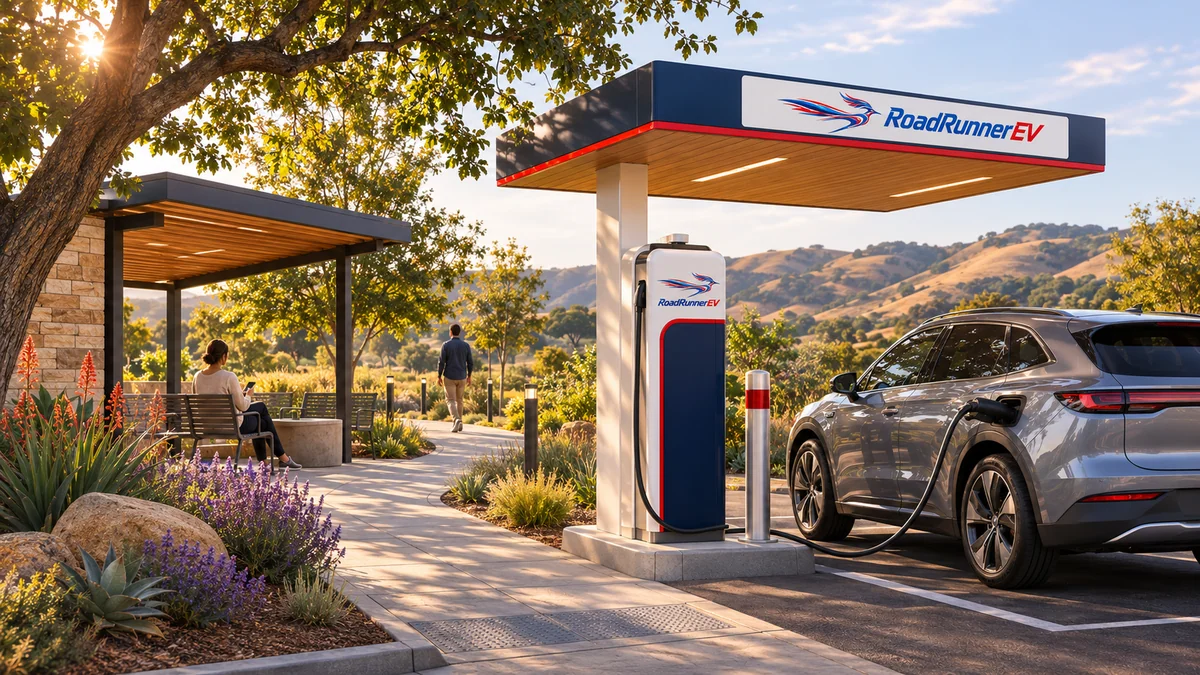
RoadRunner EV is planning charging around the whole stop: the equipment, the location, the people and the work required to keep it useful.
Development priorities
These are planning priorities for future stations. Final features, equipment and service commitments are established for each project.
Evaluate high-power DC equipment alongside utility capacity, power sharing, expected vehicle needs and expansion options.
Consider entry and exit, clear signage, circulation, accessible routes and the practical space needed for a charging stop.
Consider lighting, shade, seating and nearby food or restrooms where feasible. Amenities and access arrangements are specific to each location.
Define monitoring, driver support, preventative maintenance and repair responsibilities as part of the equipment and operating agreement.
Planning reference: U.S. Department of Energy · EV readiness and site selection.
Technology under evaluation
Tesla’s current commercial Supercharger offering is one option informing our equipment research. Tesla advertises V4 posts with up to 500 kW capability, with power shared across a site configuration.
The final RoadRunner configuration depends on the selected equipment, utility service, vehicle compatibility and executed agreements.
Tesla describes its business offer as a package of hardware, software and service. Our provider evaluation also covers payment access, remote monitoring, driver support and maintenance responsibilities.
Tesla · Supercharger for Business product information ↗ (opens in a new tab)Available power is allocated across charging sessions. This diagram is not the Yuba City equipment design.
From equipment to everyday operation
Evaluate the right additions
Solar canopies and battery storage can be evaluated alongside the site’s space, electrical needs, permits and economics. Their inclusion is a project decision, not an assumption.
Good to know
A little clarity before the first conversation.
We are evaluating high-power DC equipment, including the Tesla Supercharger for Business offering discussed in our planning materials. Final equipment selection, purchase terms and site power have not been announced.
Vehicle compatibility is part of equipment selection. We are evaluating support for NACS/SAE J3400 and CCS vehicles, including any required adapter arrangements. Confirmed connector details will be published before a station opens.
No. Delivered charging power depends on the vehicle, battery condition and charge level, equipment configuration and power available at the site. A manufacturer’s maximum rating is not a guaranteed charging speed.
No RoadRunner operating uptime result or contractual service level has been announced. Our planning priorities include remote monitoring, a clear support path, preventative maintenance and defined repair responsibilities.
Those features are evaluated for individual properties based on space, electrical needs, permits and economics. Confirmed amenities and energy systems will be described for each project.
No. Purpose-built stations, existing gas stations and other properties have different access, utility and operating requirements. The site and commercial agreement determine the final approach.
Connector and charging-level reference: U.S. Department of Energy · Electric Vehicle Charging Stations.
Let’s explore the possibilities
Bring a property, a development idea or a capital conversation. We’ll explore how the pieces could fit.